A Tribute to
American Ingenuity
American Ingenuity
Our
Collection
Collection
Our
Dedication
Dedication
The Cradle of Liberty: 1860
13 Star, Civil War Era Flag: 1861-1865
Michigan Statehood: 1837-1845
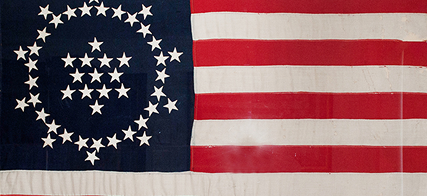
48 Star Whipple Flag: 1913
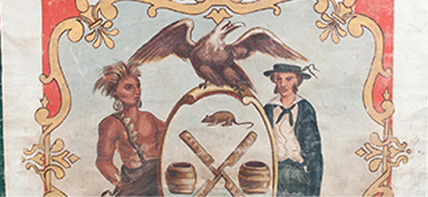
Hand-Painted Patriotic Banner: 1860-1876
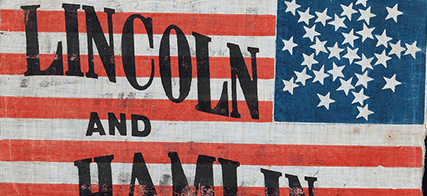
Abraham Lincoln & Hannibal Hamlin Campaign: 1860
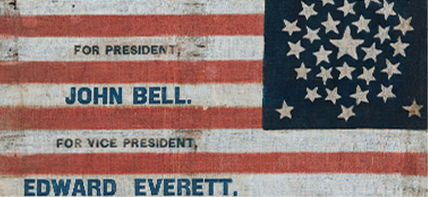
John Bell & Edward Everett Campaign: 1860
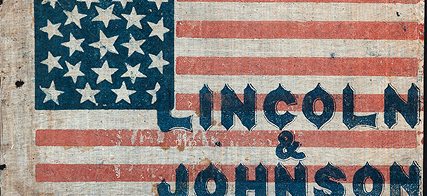
Abraham Lincoln & Andrew Johnson Campaign: 1864
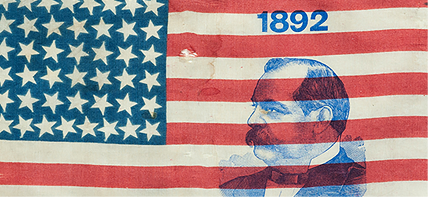
Grover Cleveland Campaign: 1884
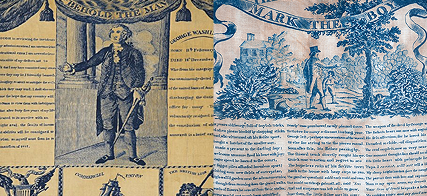
George Washington, “The Effect of Principle, Behold the Man”: 1806
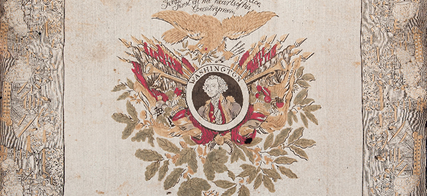
The Mourning of George Washington’s Death: Circa 1800
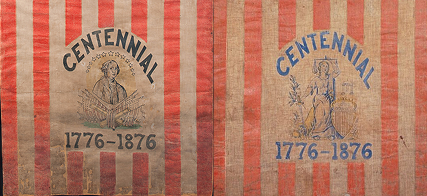
George Washington & Lady Columbia Centennial Celebration: 1876
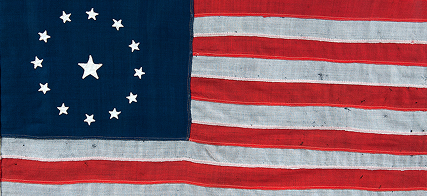
3rd Maryland Pattern: 1846-1865
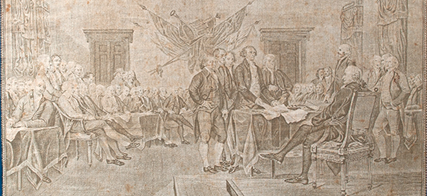
John Trumball’s “Declaration of Independence”: 1826
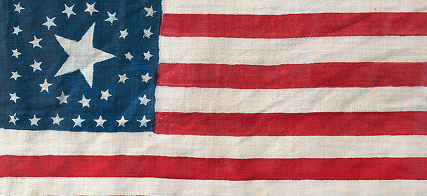
Centennial Celebration: 1876
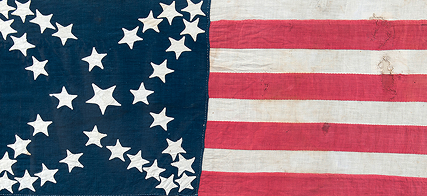
Kansas Statehood Civil War Flag: 1861-1863
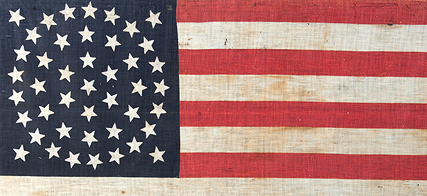
Wyoming Statehood: 1890-1896
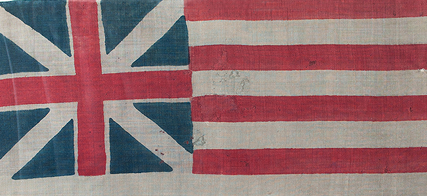
The “Grand Union”: 1876
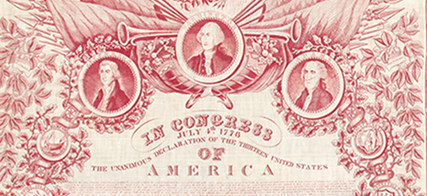
John Tumbull’s, “Declaration of Independence”: 1862
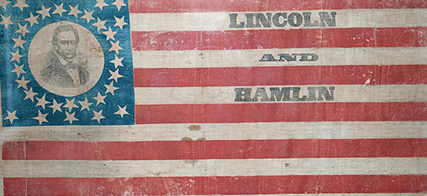
Abraham Lincoln & Hannibal Hamlin Presidential Campaign: 1860
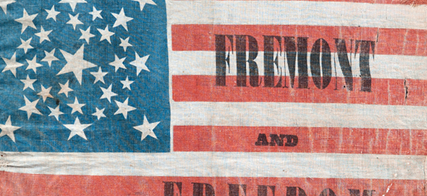
John Fremont Presidential Campaign: 1856
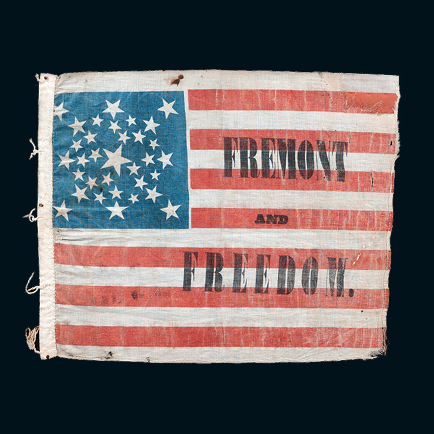
John Fremont Presidential Campaign: 1856
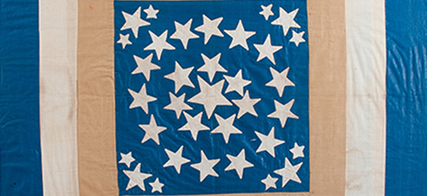
Rare and exceptional, 33 star American parade flag, printed on cotton, made for the 1856 presidential campaign of John Frémont and William Dayton. Frémont holds the important distinction of being the nation’s first Republican presidential candidate. The Republican Party had been formed in that very same year. It was an outgrowth of the Whig party, the Liberty Party, and the “Free-Soilers”, which simultaneously evaporated, plus those members of the American Party (the “Know-Nothings”) who more vigorously opposed slavery. Former members of all these groups united in a common goal to impede the Kansas-Nebraska Act.
Only three styles of Frémont campaign parade flags are pictured in Threads of History: Americana Recorded on Cloth, 1775 to the Present, by Herbert Ridgeway Collins, (1979, Smithsonian Press). Collins formerly served as Curator of Political History at the Smithsonian Institution and his text is widely agreed to be the best available reference for American political textiles. Though this particular flag does not bear Frémont’s portrait, it does bear other traits that make it one of the best political “word flags” that I know to exist. Besides the obvious importance of its ties to the very roots of the Republican Party and the scarcity of Frémont textiles, there are several reasons why. These include the rare presence of a slogan, the meaningfulness of that slogan in modern American, and one of the most dynamic star configurations that ever seen on a printed parade flag. Also important are its pre-Civil War date, its near-to-square proportions, and, last but certainly not least, the fact that the flag is an unrecorded example and the only one known to exist in this style.
Slogans are extremely scarce on political parade flags. Between the years of 1843 and 1901, the percentage of existing flags with slogans is tiny, certainly less than five percent. The slogan itself is more significant than others, simply because of the word “Freedom” and its never-ending relevance. It speaks not only to the elimination of slavery, but to our colonial struggle for independence, and, by itself, places the flag among the best of all known examples.
The star configuration equals the best ever seen on a parade flag. This consists of 5 different sizes of stars, placed in an unusual medallion format that looks quite a bit like a diamond until you examine it more closely and see that there are actually consecutive wreaths, placed so close together that they appear jumbled. This lends to the overall, diamond-shaped appearance. Further, each corner star lines up diagonally with 2 more stars, pointing toward the center star, which accentuates the diamond effect. Any way you describe it, the pattern is dynamic, highly unusual, and unique among known printed flags in any star count.
Brief History of John Frémont & William Dayton:
John Charles Frémont was born in Savannah, GA on January 21, 1813. The illegitimate son of a poor, French refugee and a prominent Virginia society woman, Frémont improved his social status by marrying Jessie Benton, daughter of leading Democrat and slave-owner, Thomas Hart Benton. Nicknamed “The Pathfinder”, Frémont led expeditions in the west both prior to and during the Mexican War. He is credited as being the first Caucasian to view Lake Tahoe and he made the determination that the Great Basin didn’t open to the sea. During the Mexican War, he led a unit into California to defeat General Pico and, in 1847, proclaimed himself Military Governor of the state. Frémont went on to become one of California’s first two senators. He became rich in the Gold Rush and in 1856 his popularity and hard stance on the abolition of slavery led him to become the youngest man to ever run for the White House and the first to run on an anti-slavery ticket. He was defeated by James Buchanan because the slave states threatened to secede and the nation as a whole was not ready for the great separation that would follow.
Lincoln appointed Frémont major general in May of 1861 and placed him in charge of the Department of the West. He personally fronted a good deal of money for the war effort, but was removed from duty for insubordination due to his freewheeling approach to the seizure of secessionist property and the emancipation of slaves. Republican allies supporting Frémont caused Lincoln to reconsider and reappointed him in 1862 to the newly formed Mountain Department, but Frémont resigned a couple of months later because of further differences. He was generally unsuccessful as a military leader, suffering several major defeats. He did begin another presidential bid in 1864, siding with the Radical Republicans, but eventually he withdrew and supported Lincoln. Frémont became territorial governor of Arizona in the 1870’s and died in new York City in 1890.
William Lewis Dayton was born in Basking Ridge, New Jersey in 1807. He was an attorney and Judge who became a United States Senator (NJ), serving the Whig Party in Congress from 1841 – 1851. He returned to law before being selected as the first Republican vice presidential candidate in 1856. He served as New Jersey’s Attorney General from 1857-1861 and was afterwards appointed Minister to France, a post he served until his death in 1864.
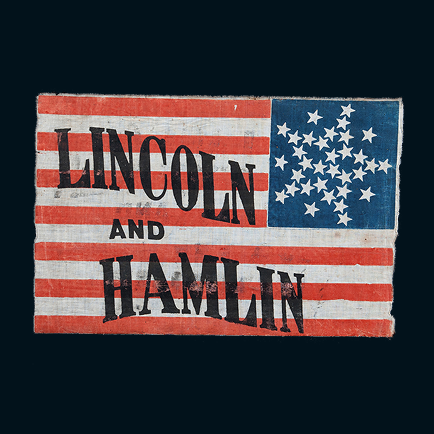
Abraham Lincoln & Hannibal Hamlin Campaign: 1860
Among printed parade flags, those made for the political campaign of President Lincoln are, collectively, the most desired. It is interesting to note that Lincoln was hardly the favorite at the beginning of the campaign, winning the Republican nomination from the 3rd ticket. He then defeated John Bell (Constitution Party), John Breckinridge (Southern Democrat), and Stephen Douglas (Northern Democrat), to become the Republican party’s first president. Lincoln was elected with a mere thirty-nine percent of the vote and carried no state south of the Mason-Dixon line.
Among collectors, the Great Star is the most coveted of all nineteenth century geometric patterns. Shortly after the War of 1812, American naval hero, Captain Samuel Reid, suggested to the president that the Great Star should be considered to become the first official star design. Reid’s primary concern was that, as more and more states joined the Union, our flag needed to be kept recognizable on the open seas. Naval use was the primary reason for the American ensign in the first place, and Reid’s proposal would have kept the star constellation in roughly the same form, and in an easily recognized design that could be quickly identified through a spyglass as the number of states grew. Reid’s proposal was rejected due to the increased cost of arranging the stars in this manner. Never-the-less, since there was no official star pattern, the great star was produced by anyone willing to make it. Its rarity today, along with its beauty, has driven the desirability of American flags with this configuration. Great Star designs take on many forms. In this particular example, note that there is a star between each arm of the large star and that there is a triangle of three stars in the very center.
The 33rd state, Oregon, entered the Union on February 14, 1859. The 33 star flag was official from 1859-1861, and was thus still the official flag when Ft. Sumter was fired upon, on April 12th of that year to start the Civil War.
Don’t be fooled by the seemingly backwards orientation. In the nineteenth century, the same flag ethics that exist today (which developed around the turn-of-the-century), did not exist. So in the mid-nineteenth century, this was every bit as correct as what we now think of as a “forwards” and ethical manner of display.
Brief Biography of Hannibal Hamlin:
Hannibal Hamlin, our nation’s first Republican vice president, was born in Maine in 1809. He was an attorney who, in his political career prior to the White House, served as Chairman of the Maine State House of Representatives, as a U.S. Congressman and Senator , before becoming Governor of the State of Maine. He was a Democrat until 1856, but was an opponent to slavery. He did not run with Lincoln in the second campaign in 1864, but did return to the U.S. Senate from 1869-1881 and served as Minister to Spain from 1881-82.
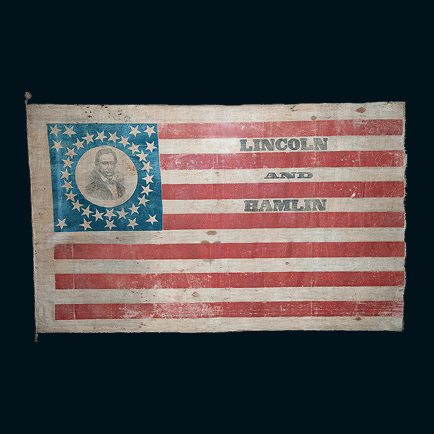
Abraham Lincoln & Hannibal Hamlin Presidential Campaign: 1860
This large scale parade flag, with 33 stars arranged in a very rare variety of single wreath pattern, is an extremely important object in the world of American flag and political campaign collecting. Not only is this due to its use by Abraham Lincoln during his first campaign for the Whitehouse with running mate Hannibal Hamlin in 1860, but far more so because of the presence of the overprinted image of his portrait in a circular medallion at the center of the canton. Among printed parade flags, those specifically used for political campaigning, with advertising of the candidates’ names, faces, and slogans, are by far the most valuable. Among this subsection, those flags pertaining to the two campaigns of Abraham Lincoln are collectively the most valuable and widely desired. There are more rare flags, such as those made for Horace Greeley, Winfield Scott, or Millard Fillmore, among which scarcely any examples have survived, but there is no nineteenth century American personality so beloved as Lincoln and no nineteenth century event that has so enamored our nation’s focus on history than the study of the Civil War. Further, among the existing flags that relate to our sixteenth president’s aspirations for our nation’s highest office, none are so sought after and desired than those containing his image. Numerous top collectors of political flags have left the hobby, or continue to collect today, without ever being lucky enough to acquire one.
All above the above facts point to the reason why Lincoln campaign portrait flags hold the top four (or more) records for the highest prices ever achieved for printed parade flags sold at public auction. In fact, as of June 2008, this particular flag is the most significant among them. The reason why lies beyond the simple fact that it is the most recent Lincoln portrait flag to reach the auction block. The most important factors are its large size and dramatic visual impact. While parade flags are typically three feet long and smaller, those just slightly larger, with dynamic graphics and specific history fetch the higher prices because they make a more dramatic statement. At approximately 25” x 40.5”, this is not only the second largest example ever recorded among all Lincoln campaign parade flags currently known to exist, but it also falls approximately among the top 1% or 2% known to have survived from any campaign.
In terms of its overall design, the flag is exceptional for other reasons. For one, it is the only flag known in this exact style. Further, note how the size of the portrait image forced the designer of the flag to employ a medallion star configuration that used only one wreath. Most medallion patterns have two or three wreaths and a single is exceptionally rare in any parade flag that exhibits the full complement of stars. And while most medallions simply have one flanking star in each corner of the canton, four in total, note how this one accommodates eleven. This was accomplished by placing two triangular groups of three in the top left and right, then five more below in what is probably supposed to be a line, from which two deviate slightly, one raised more than the other. Note also how the center-most of these five stars forces the star above it, at 6:00 on the single wreath, upward and out of position, creating a dimple at the base.
It is interesting to note that there are exactly eleven stars outside the inner wreath. This was the exact number of states that officially seceded from the Union during the Civil War among the 33 that existed at the time of the 1860 election. While there may, in fact, be no correlation, one cannot help to wonder if the person who made the flag, or the person that ordered it, was sending a subtle message. The exact, dynamic and whimsical star pattern adds substantially to the overall presentation of this extraordinary textile.
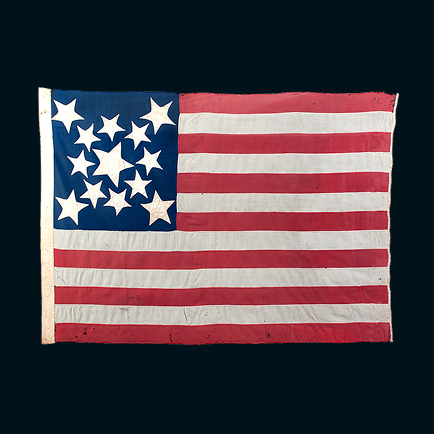
13 Star, Civil War Era Flag: 1861-1865
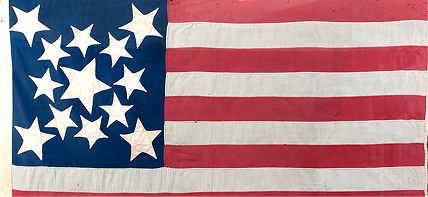
Also unusual is the flag’s extraordinarily small size for the Civil War period. During the nineteenth century, flags with pieced-and-sewn construction, made for extended outdoor use, were typically between eight and forty-five feet in length. This is because they were important in their function as signals, meaning that they needed to be seen and recognized from a great distance. A small flag was six feet in length and production of flags smaller than this was extremely limited. Even infantry battle flags were approximately six by six-and-one-half feet, about the size of an average quilt of the same period. As time passed, circumstance changed and sewn flags began to find more of a decorative purpose. But before 1890, with the exception of military camp colors (used to mark an officer’s tent) and guidons (unit marker flags), anything shorter than six feet is quite rare. Collectors generally prefer smaller flags, like this one, the size of which is ideal for a balance of visual impact and versatility in terms of modern indoor display.
Though the exact purpose of this particular flag is unknown, it was certainly homemade, maybe as a presentation gift for a politician, maybe for an individual soldier, or maybe for an entire unit. In any event it was likely a gift because it was homemade and carried or flown very little. The condition is extraordinary for the period.
The flag’s construction and materials also lend to its appeal. The tiny hand stitches and narrow seams join a variety of fine, merino wool and blended wool fabrics that often appear in the cantons of Civil war period flags, but are seldom seen used to create the stripes. This fabric would have been significantly more costly than the coarse wool bunting or lightweight cotton used in many homemade and commercial flags, so it stands to reason that the maker of the flag was probably well-to-do. The stars of the flag are made of cotton, hand-sewn, and double-appliquéd (applied to both sides). There is an open, cotton sleeve, through which a rope hoist can be threaded for hoisting and the fly end is bound with white cotton for added strength.
13 star flags have been used throughout our Nation’s history for a variety of purposes. The U.S. Navy used the 13 star count on small boats, not only in the eighteenth century, but throughout much or all of the nineteenth century, particularly the second half. This practice ended in 1916 following an executive order from President Woodrow Wilson. Some private ships also used 13 star flags during the same period as the Navy, and the use of yachting ensigns with a wreath of 13 stars surrounding an anchor, which began in 1848, still persists today. Among other uses, 13 star flags were carried by soldiers during the Mexican and Civil Wars and displayed at patriotic events, including Lafayette’s visit in 1825-26, the celebration of the Nation’s Centennial in 1876, and the Sesquicentennial in 1926.
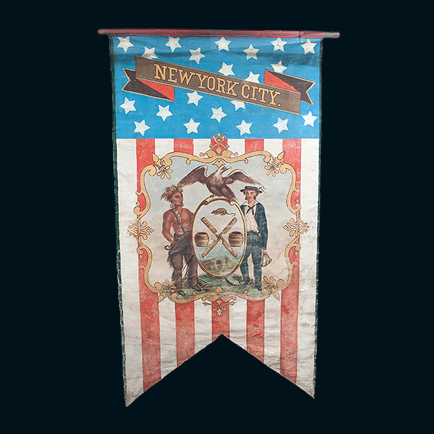
Hand-Painted Patriotic Banner: 1860-1876
Note the bold and interesting imagery, which includes a modernistic, folded streamer on a cornflower blue field of 21 visible stars, and a loose interpretation of the device of the city, executed in a folk style. There is an endearing primitive nature in the stern faces of the Native American and mutton-chop-whiskered sailor. The eagle is attractive and prominent, but the most interesting element is the animal above the Dutch windmill blades. There is supposed to be a beaver both above and below the apex, but the single mammal pictured here is clearly a rat. Though there were of course many rats in New York, the reason for its inclusion is not clear. Perhaps the artist was working from a combination of memory and his own deductive reasoning. Other differences are also present. The date of 1625 usually appears centered beneath the feet of the figures, one of which is usually depicted as a common settler, not a sailor [note the tell-tale hat, kerchief, and the sextant in the grasp of his left hand]. The Indian does not hold a peace pipe as he does here. The profile of the interior medallion is usually shield-shaped, not oval, and the eagle isn't perched directly on it. In any event, the rat is certainly a curiosity and raises the level of interest in this dynamic piece of American folk art.
It is also of interest to note that a Civil War reference might be present in the count of 21 stars. The symbolism in this star count reflects Northern Patriotism and the secession of the Slave States. It's what flag collectors call "Southern-exclusionary", removing the Southern States from the number represented.
Banners of this style were often hoisted on single vertical staffs that held the rope aloft in the center. This basic style was both carried in parades and affixed on mounts indoors. Similar decorations and banners can be seen along the walls at early political conventions, or hoisted among benches, where they denoted the positions of the seating of attendees from various states. This particular example was found among a series of banners representing Mississippi, Delaware, Oregon, Pennsylvania, Virginia, Illinois, and Louisiana. This is the only one of the group that represented a city, which suggests that whatever event they were used at occurred in New York.
The 1868 Democrat National Convention was held in Manhattan at Tammany Hall. A colorful illustration, printed for Joseph Shannon’s Manual of the Corporation of the City of New York, shows the interior of the building masterfully festooned with patriotic banners, medallions, and buntings of similar nature, but none that match this particular style. Only the front and central interior are pictured, but two full sets of state identifying decorations are shown. This banner and its mates could well have hung elsewhere on the premises. No Republican National Conventions were held in New York during the nineteenth century. An alternative possibility is that the banners were used in festivities pertaining to the centennial of American independence in 1876, either in New York or at an event such as the Centennial International Exhibition in Philadelphia, a World's Fair where New York, like each state, probably had its own pavilion.
Whatever the case may be, the textile is a boldly graphic, colorful survivor and presently represents the only privately held banner of its kind with the device of our nation's greatest city.
Construction: Painted cotton or linen tacked to a red-painted wooden staff with blue-painted acorn finials that is original to the banner. A length of red wool tape was used to reinforce the point where the tacks are affixed.
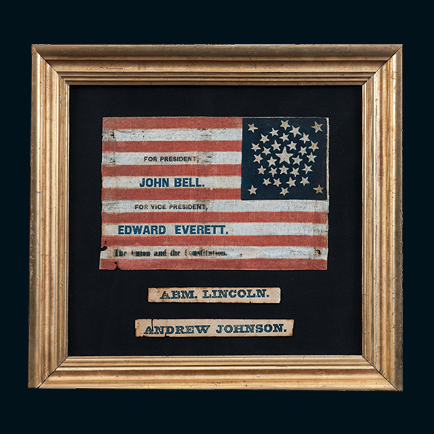
John Bell & Edward Everett Campaign: 1860
Flags made for Bell’s campaign are exceptionally rare, but what makes this one even better is the fact that the flag was recycled by Lincoln for his campaign for reelection in 1864. This was accomplished through the use paper labels that read “Abm. Lincoln” and “Andrew Johnson”, which were applied over the names of Bell and Everett.
It is interesting to note that Lincoln seems to have liked Bell’s slogan, “The Union and the Constitution”, which he left visible at the bottom of the flag. This isn’t the only time that Lincoln or his supporters recycled a flag and it isn’t the only time in which he left Bell’s slogan intact. One other Bell flag is known with the names of Bell and Everett cut away and the slogan left behind. There are also three known 1860 Breckinridge & Lane flags with the names of Lincoln and Johnson, pre-printed on cloth, appliquéd on top.
Note how the stars are arranged in a very interesting medallion pattern that, instead of being circular or star shaped, forms a pentagon. A few variations of the rare pentagon pattern are known and all are peculiar. Note that there is a star in each corner of the canton, which is typical of medallion designs, but there is also a single star at the very bottom center, which almost transforms the pentagon into an acorn.
The 1850-1865 era marked a pivotal time in American party politics. It was witness to the birth of the Republican Party in 1854, and the end of both the Whigs and the American Party (Know-Nothings), which basically disappeared in 1860. The members and ideals of these latter two groups basically diffused into the Constitutional Union Party and the Republican Party. John Bell, a southerner, was the first and only candidate for the Constitutional Union Party. He ran against Abraham Lincoln (Republican), John Breckinridge (Southern Democrat), and Stephen Douglas (Northern Democrat).
Though Lincoln won, he was hardly the favorite at the beginning of the campaign, even among Republicans, winning the party’s nomination from the 3rd ticket. But he was the clear favorite among the non-slave states, and the presence of three candidates from the Southern, slave-holding states brought about two almost inevitable conclusions, an end to the election and the beginning of our nation’s bloodiest war.
Biographical Information on John Bell & Edward Everett:
John Bell was born near Nashville, Tennessee in 1797. A 1814 graduate of the University of Tennessee, Bell passed the bar in 1816 and set up a law practice in Franklin. He was elected to the Tennessee State Senate just one year later, in 1817, then declined re-election. He became a U.S. Congressman in 1827, serving 7 terms. During this time he served as Speaker of the House, chairman of the Committee on Indian Affairs, and chairman of the Committee on Judiciary. He served a very brief term as Secretary of War in 1841. In 1847 he was elected to the Tennessee State Congress, and in the same year became a U.S. senator (Whig Party), serving nine years before his run for the presidency. The Constitutional Union ticket carried just three states, Tennessee, Kentucky, and Virginia. Bell died at his home, near Chattanooga, in 1869.
Born in Boston in 1794, Edward Everett studied abroad in Germany and returned to the U.S. as our nation’s first holder of a Ph.D. He became a professor of Greek Literature at Harvard and was a member of the Whig Party. Everett was elected to the U.S. Congress in 1825, where he served for 10 years. Afterwards elected Governor of Massachusetts (1836-1840), he then became President of Harvard (1846-49). Everett then returned to politics in 1840, serving as Envoy and Minister to England until 1845 and was appointed Secretary of State by Millard Fillmore in 1852, following the death of Daniel Webster. He was elected to the U.S. Senate in 1853, but resigned just a year later.
Everett was considered the greatest orator of the time, which is why he was selected to give a speech at Gettysburg in 1863, to dedicate the memorial to fallen soldiers. He spoke for two hours, but Americans will forever remember the day, not for Everett, but for President Lincoln, who was asked to follow with a “few appropriate remarks”. These became the Gettysburg Address. Everett died in Boston in 1865.
The gilded frame dates to the period between 1820 and 1860.
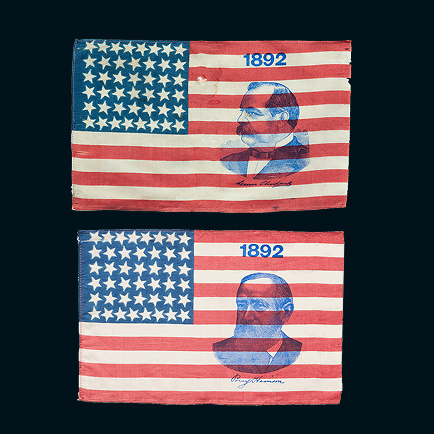
Grover Cleveland Campaign: 1884
Some political campaign parade flags were produced by one flag-maker in the same exact style for opposing candidates. Another flag in this format was made for Cleveland’s Republican opponent, James Blaine. An example of the Blaine flag is documented in “Threads of History” by Herbert Ridgeway Collins (Smithsonian Press, 1978). It was donated to the Smithsonian by members of the family that owned the Cheney Silk Company in Manchester, CT, one of the nation’s largest silk manufacturers. It is therefore is safe to assume that the Cheney company made these flags, or at the very least, the silk on which they were printed. The Cleveland example is also pictured in the Collins text, yet it did not come from the Cheney accession.
This was the first of three times that Grover Cleveland would run for president, and one of two times that he would win. He was the only man to serve two non-consecutive terms (1884-88 and 1892-96) and was the only president to get married in the Whitehouse. In 1886, at age 56, Cleveland married his 22-year old ward, the daughter of his former business partner, who subsequently bore him five children.
Cleveland, a Democrat who appealed to moderate Republicans, had first served public office as a local sheriff, then as Mayor of Buffalo, and finally Governor of New York. He was an imposing, five-foot eleven, two-hundred-sixty-pound man who was thought of as a ‘regular Joe’. By contrast, Congressman-turned-Senator, James Blaine “Of the Great State of Maine” (so hailed by his supporters), was generally regarded as pompous, flamboyant, and corrupt. This was at a time where robber-baron types, like New York’s Jay Gould, were at the height of their influence and aligned with Republican politicians.
The primary scandal of the 1884 election surrounded claims that Cleveland had a ten-year-old, illegitimate son. “Ma! Ma! Where’s my Pa?” was the chant of rival Republicans. Though the truth of the matter was never fully substantiated, Cleveland, a bachelor, owned up to the allegations publicly and paid child support, even though the mother of the boy was a widow of questionable character with regards to her promiscuities. It was suspected that he did so primarily to cover the tracks of his many married friends who could have been targeted with the same suspicion of fatherhood.
The 38th state, Colorado, joined the Union in 1876. The 38 star flag was official from July 4, 1877 – July 3, 1890.
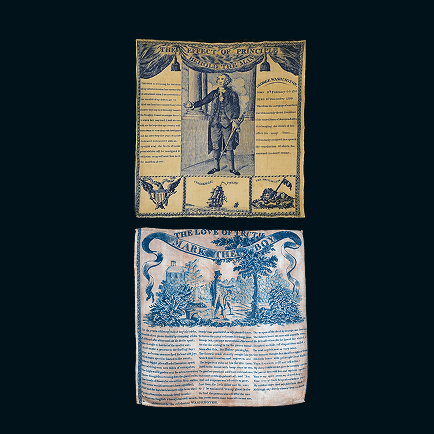
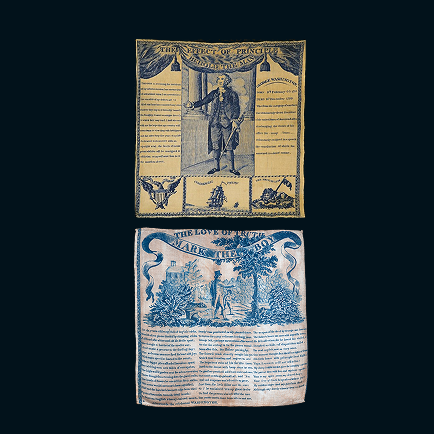
George Washington, “The Effect of Principle, Behold the Man”: 1806
The portrait is based on a mezzotint after Gilbert Stuart’s very famous painting of Washington in his later years. Stuart had painted the original in oil-on-canvas for a wealthy merchant by the name of William Constable, who commissioned the work for Alexander Hamilton. To the left of the portrait is a portion of Washington’s infamous farewell address to his troops at the end of the Revolutionary War. To the right is a short excerpt from his eulogy. Below these are three images. In the center is a square-rigged tall ship with “Commercial Union” above it, flanked by the American eagle on the left and the British lion on the right. Hewson may have produced the textiles in demonstration of his desire, and/or that of others, to advance trade with England. Commercial printers were very influential in early America because they possessed the means to disseminate information.
An example of this kerchief and its companion piece are held in the collection of Cornell University and are documented in “Threads of History, Americana Recorded on Cloth, 1775 - the Present”, by Herbert Ridgeway Collins (1979, Smithsonian Press, p. 68). The Collins text also cites an uncut pair in the collection of the Western Reserve Historical Society, Cleveland, OH. The “Effect of Principle” variety is also documented in “Running for President, The Candidates and Their Images, 1789-1896”, by Schlesinger, Israel, & Frendt, (1994, Simon & Schuster, p. 15).
1 Information on John Hewson derived from: Collins, Herbert Ridgeway, “Threads of History, Americana Recorded on Cloth, 1775 - the Present”, ( Smithsonian Press, 1979, p. 1, 2, and 68).
The Mourning of George Washington’s Death: Circa 1800
The participation of General Lafayette was also of great influence with respect to the relationship built between the two countries. The Marquis de Lafayette presented himself before the Continental Congress to offer his services as a volunteer. Because of his prominent family and their potential influence in the way of French assistance, Lafayette was given the highest military commission under that of Washington, himself. But Lafayette soon proved himself worthy of the rank and became such a close friend of the general and future president that he named his son Georges Washington Motier de La Fayette. It is interesting to note that in 2002, more than 200 years later, Lafayette was awarded honorary U.S. citizenship, becoming one of only six persons to ever receive this title.
The close ties between France and America are demonstrated here in the beautiful border of warships surrounding Washington’s portrait, many of which are firing their guns, presumably in respect to the passing the father of our country. This particular textile is of great importance for a couple of reasons. First, it is the only one of this exact type currently known to exist. Second, it is it among the earliest of all textiles depicting American presidents. In addition to these facts, it is also one of the most beautiful and interesting textiles made to memorialize Washington immediately following his death. The folky depiction of his portrait in military garb is part of an elaborate center medallion that includes the famous word uttered by his friend Henry Lee at his funeral:
“First in War. First in Peace. First in the Hearts of His Countrymen”
This text arches above an eagle that spreads its wings over a stand of flags and trumpets. Under the flags, two of which have white stars on a blue field and some of which have red and white stripes, the oval center is also flanked by bountiful cornucopia and sprigs of foliage.
It is interesting to note that another printed silk textile, most certainly from the same maker, is documented as item 22 in Threads of History: Americana Recorded on Cloth, 1775 to the Present (1979, Smithsonian Press). Compiled by Herbert Ridgeway Collins, who formerly served as Curator of Political History at the Smithsonian Institution, this book is the best available text on American political textiles. Plate 22 shows the same center medallion, but set within a sunburst center and with a border of eagles perched on grape vines. No attribution of nationality is given. Plate 23 shows a similar array of horns, flags, cornucopia, and an eagle above Washington, on a kerchief that glorifies the Declaration of Independence. Collins records this as English or American, but I would suggest that all three textiles are likely of French origin. Silks were generally French, as were many fancy cotton goods, and the design in the cotton textile in plate 23 bears great similarity.
Condition: There are losses along the edge of the fabric, caused by glue that was previously used to attach the kerchief to a board around its perimeter. There are more minor splits and losses in the body of the kerchief, accompanied by minor foxing, staining, and fading. The great rarity of the textile as the only known example, as well as its early date, warrant practically any condition. The fact that it survived at all is remarkable for the period and silk construction.
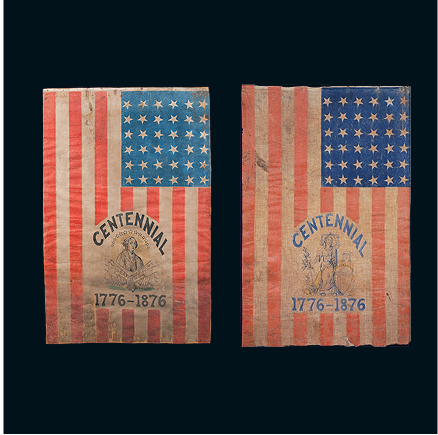
George Washington & Lady Columbia Centennial Celebration: 1876
Besides being large, graphic, and stylistically unusual, each of these flags is one of only two known to exist in each style and no other collection includes both examples.
The Washington flag is very important among all known printed flags, because it may be the most often photographed and published parade flag of any kind. This exact flag was formerly part of the Mastai collection of American flags and appears in no less than books on flag collecting, including the Mastai’s own book “The Stars & The Stripes” (1973, Knopf, New York), “Threads of History” by Collins (1978, Smithsonian Press), and “The Official Price Guide to World’s Fair Memorabilia by Friz (1989, House of Collectibles).
The Washington flag was a significant item in the collection of Boleslaw and Marie-Louise D’Otrange Mastai, who were the first significant collectors who actually produced a book on the subject. Their 1973 text serves as a landmark in flag collecting. The flag is marked along the hoist, not only with the Mastai stamp (in red ink), but also with their inventory number (item 103). The Mastai’s marked almost all of their flag-related objects in this fashion and while it’s hard to argue that it can be considered defacement, the fact remains that it is an important mark to collectors because it records the flag’s former presence among the items in the first and most widely recognized private collections of American in the world.
The Lady Columbia is extraordinary because of its five color design. Only one other like it is known, but two are known in a larger size with a different portrait. In the other style, she holds a flag on a pole that is topped with a liberty cap. Her person is also flanked by different objects, including an eagle, a shield, olive branches, a cannon barrel, and a rose. Few parade flags, if any, are known before this time or after, with overprinted designs that are as extravagant as the Lady Columbia examples or that employ so many colors.
On the Lady Liberty flag, large letters that were to read “Hayes and Wheeler” are penciled under the canton. The owner of the flag obviously intended to use it to promote the presidential campaign of Rutherford B. Hayes, but for some reason the text was never completed. Hayes ran for the White House and won in 1876, in one of the most unusual elections in American presidential history, whereby he lost the popular vote but won in the Electoral College under controversial circumstances. It is interesting to note that the other Lady Liberty flag in this same style actually has a the words “Hayes & Wheeler” overprinted on it in black ink. So it is entirely possible that Hayes was using these flags in his campaign, gifting them to supporters and it is reasonable to assume that the same may have been true of the Washington examples.
The use of 36 stars on flags made for the 1876 Centennial International Exposition, when we actually had 37 states (until August 10th) or 38 states (afterward and until November of 1889) was not uncommon. It was probably a matter of convenience, being easy to design with no further underlying purpose.
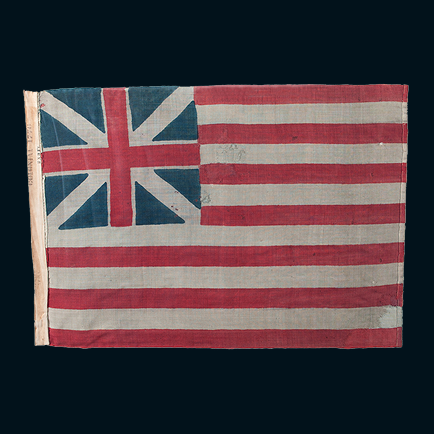
The “Grand Union”: 1876
The “Grand Union” is the most commonly used name for the first American national flag. This was the design that was in use at the opening of the Revolutionary War, between 1775 and 1777, under the First Continental Congress, when America was still a colony of Britain. Like other outposts of the British Empire, this flag employs the Union Jack image in the canton, accompanied by a field that somehow reflects the respective dominion or territory. In this there are 13 red and white stripes to signify the 13 colonies.
The first documented appearance of the Grand Union flag occurred after it was apparently raised by First Lieutenant John Paul Jones over the Continental Navy's first flagship, “Alfred”, on December 3, 1775 in Philadelphia. The act was recorded in letters to Congress.
While American ground forces did not customarily fly a national flag until 1837, George Washington seems to have found it fitting to do so as Commander-in-Chief. Washington stated in a letter that he raised the “Union flag” for the first time on January 1st, 1776, to honor the newly formed Continental Army at Cambridge, Massachusetts. In his book "Standards and Colors of the American Revolution" (1982, University of Pennsylvania Press, Philadelphia), author Edward Richardson states the following: "The Continental Union [flag] was a natural selection for the Americans in 1775. It did not signify rebellion but rather continued loyalty to the mother country." He continues, "It was only after the Declaration of Independence and the bitter fighting of 1776, that the British Grand Union in the canton lost favor." That said, an image of the flag appears on a scrimshaw powder horn dated December 25, 1777, illustrating Fort Schuyler, New York. So assuming that the image is accurate, the Grand Union was still in use six months after it was officially replaced by the Stars & Stripes.
Despite its importance of as the first American flag, few people now recognize the Grand Union design. It seems clear that it was soon forgotten after the Stars & Stripes emerged and the war gained momentum. Ties to England were eventually severed and reminders of British rule were either swept under the carpet or aggressively defaced. In any event, the Grand Union never became popular to reproduce. nineteenth century reproductions of it are practically unknown. Today perhaps seven copies exist, of which this is one. Like this flag, all appear to date to the 1876 centennial of American Independence, though one may be earlier and one may be slightly later.
Press-dyed on wool bunting, the flag is signed with an inked stencil that reads: "Horstmann, Phila." It was found with two 38 star American nationals flags (1876-1889), and a group of international flags, all of which bore the same construction and like markings. Horstmann & Brothers Company was a major military goods manufacturer and dealer. The firm opened in 1816, but is best known for the significant role it played in the outfitting of Civil War soldiers. In 1876 Horstmann supplied many flags to the Centennial International Exhibition, a six-month-long World's Fair held to celebrate our nation's 100-year anniversary of independence. Given the scale of the fair, which was massive, one might expect that many international and colonial pattern flags would have been required. It is therefore surprising that practically none have survived to the twenty-first century. The Grand Union is the only one of its kind and the international flags that accompanied it are likewise singular.
This flag was formerly in the collection of J. Richard Pierce and is documented in his book, "The Stars & The Stripes: Fabric of the American Spirit" (J. Richard Pierce, LLC, 2005), p. 27.
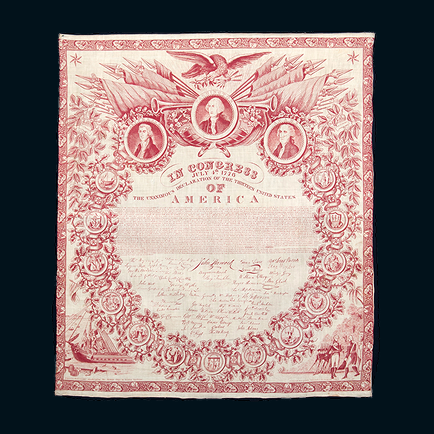
John Tumbull’s, “Declaration of Independence”: 1862
Below the image are printed sketches of each man’s portrait and an accompanying legend that identifies each by way of his printed signature.
Many have mistakenly called Trumbull’s painting “The Signing of the Declaration of Independence”, but what it actually portrays is the presentation of the original draft of the document to the Second Continental Congress on June 28th of that same year. This is why the illustrated men represent only 42 of the 56 who eventually signed the Declaration, while 5 of those present did not sign it at all. The draft was presented by “The Committee of Five”. Led by Thomas Jefferson (VA), this group included John Adams (MA), Benjamin Franklin (PA), Robert Livingston (NY), and Roger Sherman (CT). They stand before the table in the center of the illustration.
Trumbull painted many of these men from life and visited Independence Hall in order to get the elements of the interior correct. Trumbull was known for his accuracy of detail, so of notable interest is the rather ironic presence of crossed British flags on the wall in the background. His original painting now hangs in the Yale University Art Gallery, our nation’s first university museum, which Trumbull both designed and furnished with 88 of his personal works, sold to Yale in 1831 in exchange for a $1,000 annuity. Most of the fame of the painting, however, comes from the 12 x 18 foot copy that was commissioned from Trumbull by Congress in 1817 and placed in the United States Capitol Rotunda in 1826, where it remains today.
An example of the bandanna is pictured in “Threads of History” by Herbert Ridgeway Collins (Smithsonian Press, 1978, p. 200, item 418). Collins formerly served as curator of political history at the Smithsonian and his text is considered the definitive reference on American political textiles. In the text, Collins dates the illustrated kerchief to 1876, under the surmise that it was made in conjunction with the 100-year anniversary of our nation’s independence. This date is certainly incorrect. The kerchief is of very large format when compared to those of the late nineteenth century. To this end it more closely resembles the kerchiefs made between the last quarter of the eighteenth century and the 1850s. The textile has a very early appearance, partly because the illustration was made from a copperplate engraving and partly because the sepia and nut brown ink used within are common in pre-Civil War textiles. In addition, the binding of the top and bottom is hand-sewn with very fine precision. This is not the case with ca 1876 kerchiefs, which are more likely to be bound with a treadle machine. Since none of these traits point to the late nineteenth century, the kerchief was not made to celebrate 100 years of American Independence in 1876, but rather 50 years of independence in 1826 (our semi-centennial or quinquagenary). This would coincide with the hanging of Trumbull’s painting in the Rotunda and would thus better explain not only its size, coloration, and construction, but also its purpose.
Surviving examples of these kerchiefs are extremely rare. This particular example is the only one seen in this exact variety. While similar bandannas are known, all differ slightly from one-another. One is identical save for the fact that the border is brown instead of blue. A third example, in blue, shows the same image on top, in slightly smaller format, but instead of the sketched portraits below, it contains only signatures. The copy in the Collins book actually differs slightly from all of the above because the word “Independence” is misspelled “Independance”. TH Collins book also speak of another example with the word spelled correctly, but the color is unspecified.
On the original painting, many have noted that Jefferson’s foot, which is pointed at a somewhat odd angle, is purposely stepping on that of Adams. The two men were political enemies, so it is supposed that this was done on purpose. Close inspection, however, revealed that their shoes were merely close to one-another. Trumbull widened the distance in the Rotunda copy and a clear separation of their feet can be seen in the reproduction of the image on the kerchiefs.
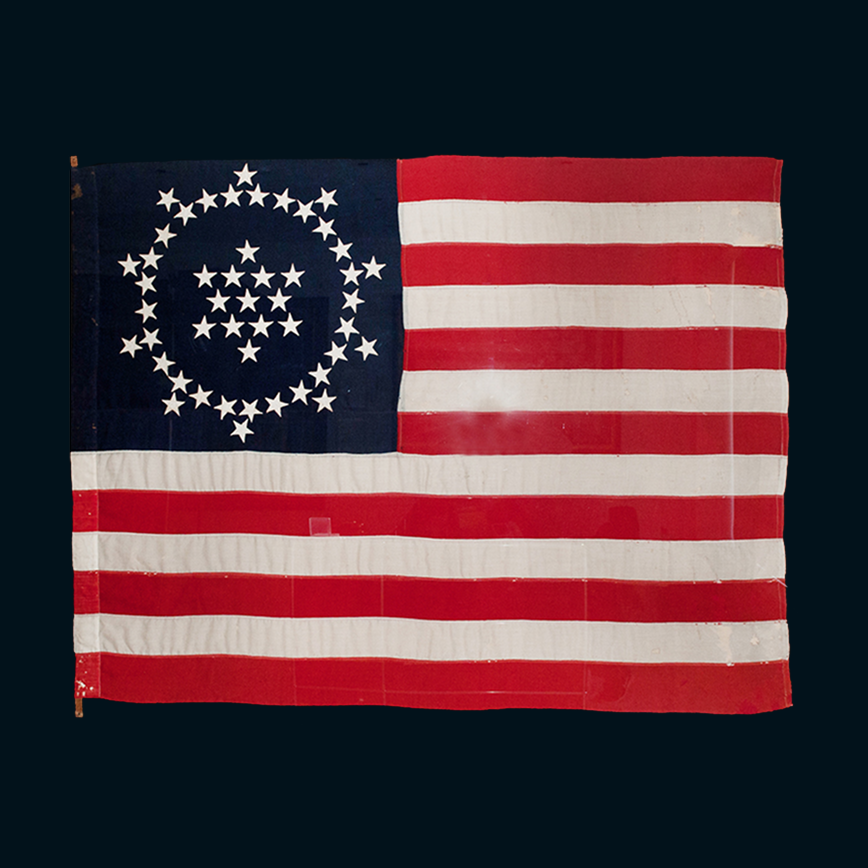
48 Star Whipple Flag: 1913
The Whipple configuration includes 13 stars in the center for the 13 original colonies, arranged in a 6-pointed Great Star or Star of David pattern that is seen on some early 13 star flags. Around this is a wreath of 25 stars which represent the number of additional states that had been added by the time of the nation’s Centennial Celebration in 1876. Stars could be easily added to the outer wreath of 10 stars, without changing the basic design. This was one of the reasons that Whipple felt it would be not only beautiful, but functional.
All previously known versions of Whipple’s flags are printed. Several sizes exist, as well as triangular, patriotic pennants. But versions of Whipple design with sewn construction (appliquéd stars, pieced stripes, and a formal sleeve), were, until now, unknown in the flag collecting hobby.
Measuring approximately 4 x 5 ½ feet, this is the only sewn example of a Whipple flag known to exist. It may be the only one, since it was specially commissioned by Whipple and sent to President Howard Taft on the 5th of February, 1913. A hand-written letter from Whipple to the president accompanies the flag. Both the letter and the flag were returned to Whipple through the War Department. The letter bears a White House stamp that is dated February 7th, and a War Department stamp dated February 11th. The flag was also returned to Whipple, accompanied by two other letters (typed together on one sheet of paper), signed by Chief of the Quartermaster Corps and the Assistant Secretary of War.
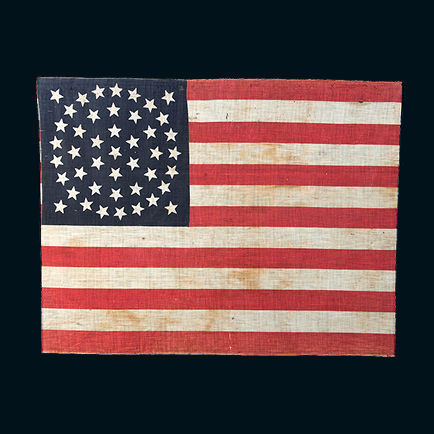
Wyoming Statehood: 1890-1896
Another significant reason for the desirability of this particular example is apparent in the design itself. Note how the beautiful, orderly, circular arrangement of such a large star count is reminiscent of a clear sky on a summer night, filled with stars. Also note that the proportions of the flag are rather square, which provides some additional visual impact to this great example of nineteenth century flag-making.
The 44th state, Wyoming, gained statehood on July 10, 1890. Many flag makers would have begun to add a 44th star to their flags on or before that day, and the 44 star flag would have generally seen use until the addition of Utah in 1896.
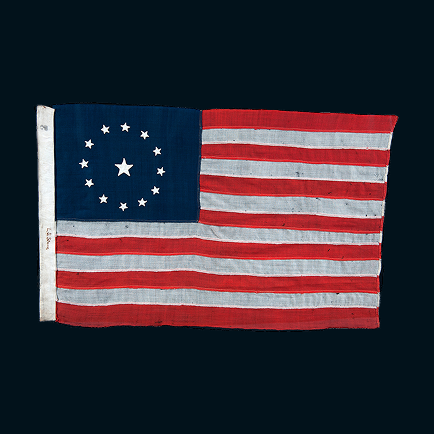
3rd Maryland Pattern: 1846-1865
The stars of this particular flag are arranged in a circular wreath of 12 with a large star in the center. This basic configuration, whether oval or circular, has come to be known as the "3rd Maryland Pattern". The design is desirable due to both its visual attractiveness and the scarcity of its use. The name comes from a flag that resides at the Maryland State Capitol in Annapolis that was long thought to have been present with General Daniel Morgan at the Battle of Cowpens in 1781. According to legend, the flag was supposedly carried by Color Sergeant William Batchelor of the Maryland Light Infantry and was donated to the State of Maryland by Batchelor's descendants. The story was disproved in the 1970s, however, following an examination by the late flag expert Grace Rogers Cooper of the Smithsonian, who discovered that the Cowpens flag could date no earlier than the 1840s based upon its construction.
Despite the inaccuracy of the label, the name "3rd Maryland" stuck to the design and is widely used among flag collectors and enthusiasts. Interestingly enough, the pattern does have true Maryland history. A similar flag, in the collection of the Smithsonian’s National Museum of History & Technology, was carried by the Maryland and District of Columbia Battalion of Volunteers during the Mexican War. So the name does have known applicability to another Maryland regiment. In my experience this star pattern is most often seen among surviving examples that date to the mid-nineteenth century, roughly between 1840 and the Civil War (1846-1865). It was also revived in small scale, commercially-produced flags within the 1890-1920s era.
This particular flag was probably made during the Civil War. Its purpose was probably to be flown on a small craft that ferried sailors back-and-forth to shore, or to be flown on the gaff or yard arm of a larger vessel, or perhaps on the pilot house as the captain's own flag. It was probably not a military flag because the pattern is not one that was preferred by the U.S. Navy, but ship captains were their own breed and there is lots of variation in Civil War flags.
The stars have an extraordinary feature. Across the thousands of wool bunting flags seen that date to the nineteenth century, the tiny stars in the circular ring of 12 are some of the smallest that ever encountered. Hand-sewn and single-appliquéd with brown cotton or linen thread, they are endearingly beautiful.
The small scale of the flag itself is also extraordinary among known examples of the period. Prior to the 1890s, most flags made for extended outdoor use were very large. Those with sewn construction were generally eight feet long and larger. This is because flags needed to be seen from a distance to be effective in their purpose as signals. Collectors generally prefer small examples, like this one, which can be more readily displayed.
Due to a combination of the star pattern, the tiny stars, the small scale of the flag, the Civil War era date, and its attractive visual qualities, this is both a beautiful and highly desirable example among 13 star flags of the mid-nineteenth century.
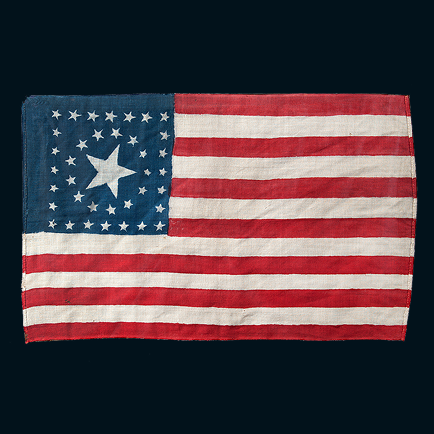
Centennial Celebration: 1876
Many fantastic star patterns were made in the patriotism that accompanied or nation’s 100-year anniversary of independence in 1876 and this is among the best of all examples. Note how the vertical alignment of the stars varies greatly and that the center star tilts in the 1:00 position. There were no regulations concerning either star configuration or position until 1912, and many flag-makers went out of their way to catch the attention of potential buyers.
It is very likely that this flag was made for Horstmann Brothers, a major military outfitter. Horstmann did not make their own flags, but marked their name on many of the things they sold. Of the other known examples of this exact flag, two have sleeves sewn along the hoist, on which the Horstmann name was printed. Due to the fact that the company was located in Philadelphia, and the fact that this flag was found in the Philadelphia area, and the fact that the Centennial International Exposition took place in the same city in 1876, it is logical to assume that Horstmann supplied these flags for this event.
Though cotton absorbs water, most parade flags were made of cotton, because cotton was inexpensive and such flags were often intended for just one day’s use only at a specific parade, rally, or reunion of soldiers. The Centennial Expo lasted for six months, however, requiring decorative flags that would last for a much longer time frame. It is reasonable to assume that press-dyed wool flags were made for just such a purpose, because wool sheds water is more appropriate than cotton for extended outdoor use.
The 38th state, Colorado, received its statehood on August 1, 1876. This was just 28 days after the official anniversary of our nation’s independence, which occurred on July 4th. Although 37 was the official star count in 1876, flag-making was a competitive venture, and no one wanted to be making 37 star flags when others were making 38s. It is for this reason that 38 and 13 (made to commemorate the original 13 colonies) are the two star counts most often seen at the centennial celebration. The 38 star flag was generally used until 1889, when four new states joined the Union.
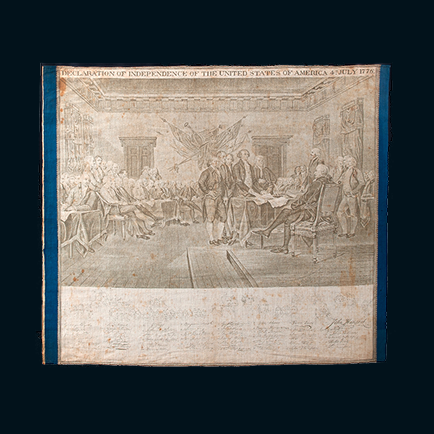
John Trumball’s “Declaration of Independence”: 1826
Printed on cotton, this extraordinarily detailed, large format kerchief pays respect to the Declaration of Independence through its depiction of the famous oil on canvas painting by John Trumbull, George Washington’s aide-de-camp and accomplished painter of historical images. Above the image is the following text:
“Declaration of independence of the united states of america 4th july 1776”.
Below the image are printed sketches of each man’s portrait and an accompanying legend that identifies each by way of his printed signature.
Many have mistakenly called Trumbull’s painting “The Signing of the Declaration of Independence”, but what it actually portrays is the presentation of the original draft of the document to the Second Continental Congress on June 28th of that same year. This is why the illustrated men represent only 42 of the 56 who eventually signed the Declaration, while 5 of those present did not sign it at all. The draft was presented by “The Committee of Five”. Led by Thomas Jefferson (VA), this group included John Adams (MA), Benjamin Franklin (PA), Robert Livingston (NY), and Roger Sherman (CT). They stand before the table in the center of the illustration Trumbull painted many of these men from life and visited Independence Hall in order to get the elements of the interior correct. Trumbull was known for his accuracy of detail, so of notable interest is the rather ironic presence of crossed British flags on the wall in the background. His original painting now hangs in the Yale University Art Gallery, our nation’s first university museum, which Trumbull both designed and furnished with 88 of his personal works, sold to Yale in 1831 in exchange for a $1,000 annuity. Most of the fame of the painting, however, comes from the 12 x 18 foot copy that was commissioned from Trumbull by Congress in 1817 and placed in the United States Capitol Rotunda in 1826, where it remains today.
An example of the bandanna is pictured in “Threads of History” by Herbert Ridgeway Collins (Smithsonian Press, 1978, p. 200, item 418). Collins formerly served as curator of political history at the Smithsonian and his text is considered the definitive reference on American political textiles. In the text, Collins dates the illustrated kerchief to 1876, under the surmise that it was made in conjunction with the 100-year anniversary of our nation’s independence. This date is certainly incorrect. The kerchief is of very large format when compared to those of the late nineteenth century. To this end it more closely resembles the kerchiefs made between the last quarter of the eighteenth century and the 1850s. The textile has a very early appearance, partly because the illustration was made from a copperplate engraving and partly because the sepia and nut brown ink used within are common in pre-Civil War textiles. In addition, the binding of the top and bottom is hand-sewn with very fine precision. This is not the case with ca 1876 kerchiefs, which are more likely to be bound with a treadle machine. Since none of these traits point to the late nineteenth century, the kerchief was not made to celebrate 100 years of American Independence in 1876, but rather 50 years of independence in 1826 (our semi-centennial or quinquagenary). This would coincide with the hanging of Trumbull’s painting in the Rotunda and would thus better explain not only its size, coloration, and construction, but also its purpose.
Surviving examples of these kerchiefs are extremely rare. This particular example is the only one seen in this exact variety. While similar bandannas are known, all differ slightly from one-another. One is identical save for the fact that the border is brown instead of blue. A third example, in blue, shows the same image on top, in slightly smaller format, but instead of the sketched portraits below, it contains only signatures. The copy in the Collins book actually differs slightly from all of the above because the word “Independence” is misspelled “Independance”. TH Collins book also speak of another example with the word spelled correctly, but the color is unspecified.
On the original painting, many have noted that Jefferson’s foot, which is pointed at a somewhat odd angle, is purposely stepping on that of Adams. The two men were political enemies, so it is supposed that this was done on purpose. Close inspection, however, revealed that their shoes were merely close to one-another. Trumbull widened the distance in the Rotunda copy and a clear separation of their feet can be seen in the reproduction of the image on the kerchiefs.
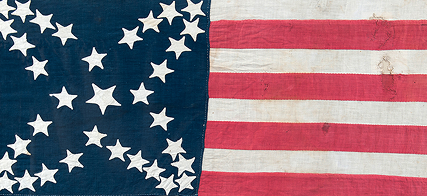
Kansas Statehood Civil War Flag: 1861-1863
In addition to the extraordinary star pattern, the flag has another feature that is almost as rare and of similar significance to collectors. Instead of having 7 red and 6 white stripes, beginning and ending with red, the flag has 7 white and 6 red, beginning and ending on white. This circumstance tends to be associated with much earlier flags and primarily exists in eighteenth and early nineteenth century illustrations as opposed to surviving examples.
One may note that the canton of this flag is also larger than usual, resting on the 9th stripe instead of the 7th. Because of the scale of the flag, this results in a profile that is somewhat more square in shape than most of its counterparts.
Adding to the flag's appeal is its tiny scale among those with of piece-and-sewn construction. During the nineteenth century, sewn flags [as opposed to those that were printed on cloth] were typically eight feet long and larger. This is because they were important in their function as signals, meaning that they needed to be seen and recognized from great distance. A flag that was six feet in length was considered small and production of flags smaller than this was extremely limited. Flags smaller than five feet, when they were made at all, would usually have 13 stars. Those with a count that reflected the number of states at the time of manufacture were few and far between. Both of these circumstances, meaning a combination of the tiny size of this example (at approximately two feet by just under three feet) among its counterparts and the fact that it contains the complete star count, add considerable interest to flag collectors. Smaller flags are more scarce and far easier to frame and display.
Kansas was admitted into the Union as the 34th state on January 29, 1861, about 2 ½ months before the Confederate assault on Fort Sumter that marked the beginning of the Civil War. The 34th star was officially added on July 4th of that year, but most flag makers would have added a 34th star with the addition of Kansas in January. The star count remained official through the opening two years of the war, until July 3, 1863, and 34 star flags would have generally been produced until the addition of West Virginia in June of that year.
The combination of the beauty of the star configuration, the non-traditional stripe arrangement, and the rarity of both, when combined with the small size and Civil War period manufacture, result in a flag of masterpiece quality and significance.
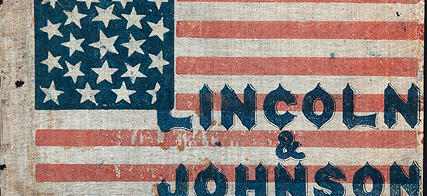
Abraham Lincoln & Andrew Johnson Campaign: 1864
The graphics of the flag are both unusual and attractive. Of particular interest is the fanciful blue text that was printed contemporaneously with the canton. This particular whimsical typeset has never been seen before a political campaign textile.
But the most interesting feature of this flag is hidden within its count of 21 stars. The symbolism in this star count reflects Northern patriotism and the secession of the slave states. It’s what flag collectors call “Southern-exclusionary”, removing the Southern states from the flag.
During the Civil War, Lincoln’s goal was to preserve the Union. It was his intent not to recognize Southern secession and to fight for the right of freedom for all Americans living within these respective states. And it is for this reason that the president fervently pleaded, as well as officially required, that those stars representing the secessionist states be kept on the national flag.
During the nineteenth century, flags made under government contract generally held to the few official specifications that were in effect at the time (namely the official number of stars and stripes). Individuals generally did what they wished, however, and all manner of liberties were taken with the design of the Stars & Stripes. This is especially true with regard to the manufacture of wartime flags, where there was much to express. So many instances are seen in surviving flags of this era, where the star count was reduced to exclude the Southern states.
Because the number of Confederate states grew from 7 to 11 in 1861, and because there were between 4 and 5 border states with a distinctly Southern lean (4 until 1863 and 5 thereafter), the star count on a Sothern exclusionary flag can be calculated in a number of ways. Although the total number of stars represents whatever the maker felt deemed loyal to the Union at the time, the most common counts on such flags seem to be 20, 21, and 22.
At the beginning of the war, a count of 21 is rather easy to calculate. 34 total states less 13 slave states equals 21. 11 states officially seceded from the Union in 1861, and the residents of 2 bordering slave states (Kentucky and Missouri) voted for secession, but the vote was not ratified by their respective state congresses. 13 stars appear on many Confederate battle flags, however, for precisely this purpose, paying homage to the overall sentiments of these two states.
There were two more border states at this time with a distinctly Southern lean (Maryland and Delaware), but residents of these states did not vote in favor of secession. In 1863, West Virginia broke off from Virginia and joined the Union as a non-slave state. Its residents retained Confederate sympathies, however, and it was universally seen as a fifth border state. Even so, makers of exclusionary flags seem to have kept the 35th star, probably because it had just been added and it thus seemed unreasonable to remove it. 20 or 22 stars can thus can be expected in a Southern-exclusionary flag of this period, representing either 35 less 13 (11 plus Kentucky and Missouri) or 35 less 15 (11 plus 4 border states). If all 5 border states were to be removed, 19 would be a possible count. But since 19 star flags are practically non-existent, the 35th star seems to have been kept by most persons removing stars for Confederate sympathizing states.
As early as July of 1864, flag-makers began to add a 36th star to the flag for the impending addition of Nevada, which officially gained statehood in October, pushed through by Lincoln just 8 days before the election. While small in population, Nevada was a free state with Republican sentiments and ample natural resources with silver as its primary commodity. It was for this reason that 21 again became a likely star on Southern-exclusionary flags (36 less 15).
While 21 stars can be seen on homemade flags of the period, this count never has never been seen before on a commercially-manufactured, printed parade flag. Further, the basic configuration of the stars is extremely rare. The configuration is sometimes referred to as a “bracketed” design, or one that contains “parenthesis” of stars, with a large star at the very center. Note how there is a smaller star above and below the center star to create a column. This is bracketed by crescent-shaped “parenthesis” of stars, followed by another vertical column at each end.
So as far as is presently known, this flag survives as the only known parade flag with 21 stars, on a wartime flag, used for one of the most desired campaigns in political flag collecting, with a symbolism that the respective president strongly opposed, yet conveyed the public sentiments of the time, and a very rare star configuration. All these facts add up to an immensely important example of early American flag-making.
Brief Biography of Andrew Johnson:
Andrew Johnson was born in North Carolina in 1808. He led an impoverished childhood and would become one of only eight presidents who never attended college (the others being Washington, Jackson, Van Buren, Taylor, Fillmore, Lincoln, Cleveland, and Truman). Johnson, in fact, was never formally educated and taught himself to read. He was an extremely charismatic speaker, however, and his political aspirations eventually led him all the way to the United States House of Representatives, followed by the Senate.
Having moved to Tennessee, Johnson played the fine line between the North and the South. As a result, he was eventually disliked on both sides of the Mason-Dixon. He often supported slavery, at least in his actions if not his words, yet was the only Senator to not denounce his seat after the secession. This earned him the title of “traitor” in the South and “hero” in the North, at least for a time. Lincoln chose him as a running mate to boost support among Southern sympathizers, as well as to convey his commitment to unification.
After Lincoln’s 1865 assassination, Johnson ascended to the presidency. Radical Republicans hated him due to political clashes regarding reconstruction. Many viewed Johnson’s actions as obstructive and endeavored to undue him, which led to impeachment. The charges were based on questionable technicalities, however, and fueled by political scheming. Johnson was acquitted at trial in 1868 and was not re-nominated.
Mounting: The flag has been hand-stitched to 100% cotton, black in color, which has been washed and treated to reduce excess dye. An acid-free agent was added to the wash to further set the dye and the fabric was heat-treated for the same purpose. A length of 100% natural fabric, off-white in color, was also placed behind the flag as a barrier and to strengthen its color against the black background. Spacers keep the textile away from the glass, which is UV protective.
Condition: There is minor to moderate foxing and staining throughout, accompanied by minor fabric loss. The flag has a great presentation, however, and its great rarity warrants any condition.
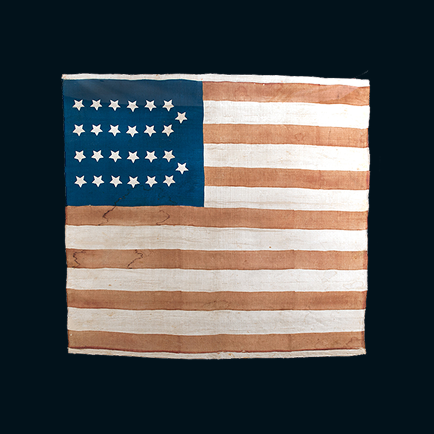
Michigan Statehood: 1837-1845
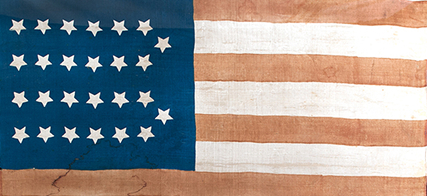
The 26 star flag became official on July 3, 1837, and remained so until the addition of the 27th state in 1845. The earliest known parade flags have either 26 or 13 stars, the latter made during this same eight-year period with patriotic respect for our colonial past. There are but a small handful of 26 star parade flags known to exist. Most of these have overprinted political advertising for the presidential campaigns of William Henry Harrison (1840), Henry Clay or James Polk (1844). The remainder, without political advertising, like this flag, number fewer than 15. Most of the known examples are almost square in shape. This probably reflects the square shape of silk militia flags and regimental banners and, at the same time, would have readily allowed women to use the flags as scarves to drape over their bonnets at parades or political rallies. Most, however, were at some point tacked to staffs in traditional parade flag format.
Four flags are currently known to exist from this particular manufacturer, the name of which is unknown. All four flags have nearly square proportions and are nearly identical in size, made of the same grade of silk, and bear the same “Double-C” star configuration. One of the four is printed in waving format, with appropriate shadowing and a printed image of a whimsical staff along the hoist end. The other two are flat, like this one, like most all other known parade flags.
The fact that the canton rests on a red stripe is a very rare trait. Some flag historians refer to this as the “blood stripe” or the “war stripe”, suggesting the flag was sometimes constructed in this manner when the nation was at war. There is also evidence that the Navy used this design feature on at least some of its flags made during the mid-nineteenth century. And sometimes the placement was undoubtedly by accident. In any event, the war stripe feature is a highly desired feature in early American flags, and it is particularly rare in printed examples.
The combination of the very early date, unusual star configuration, war strip feature, silk construction and beautiful presentation, combine to make this a fantastic example among known parade flags.